نوع مقاله : مقاله پژوهشی
عنوان مقاله English
نویسندگان English
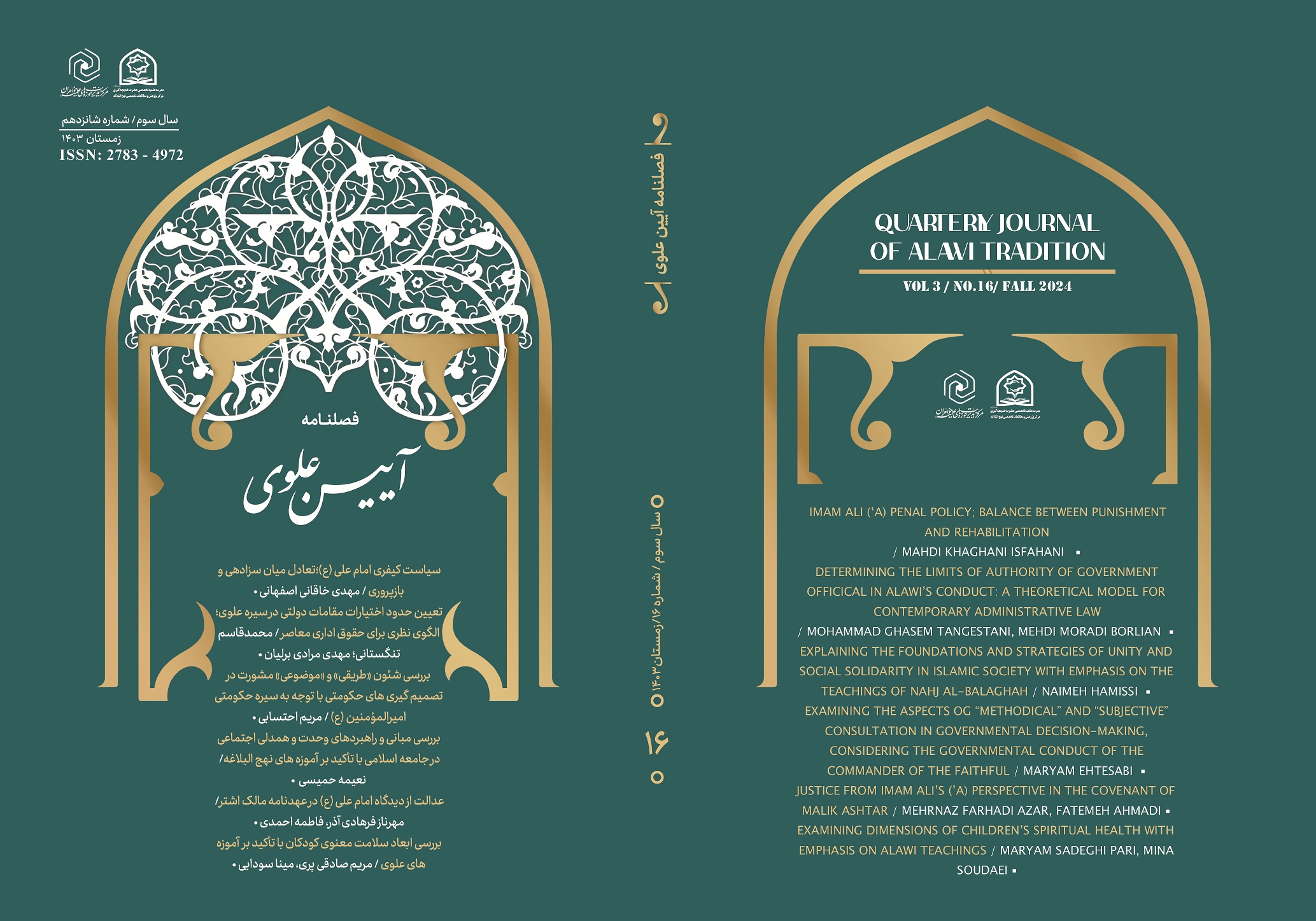
The issue of “limits of authority of government officials” in administrative law is not merely a technical discussion about competence and delegation, but rather the intersection of three normative horizons: the trust of power, the dignity of citizens, and the efficiency of administration. Relying on Alawi’s conduct, the present article demonstrates that in the tradition of Imam Ali’s (‘a) governance, political authority is understood as “trustworthy guardianship”. Therefore, Alawi’s conduct has the potential to go beyond the level of moral preaching and be translated into a legal framework for limiting and guiding administrative discretion in contemporary governments. The method of the present research is based on “text-based normative reconstruction”: intra-textual analysis of letters, sermons and executive orders of Imam Ali (‘a), especially Malik al-Ashtar’s Covenant, and their conceptual comparison with the fundamental principles of administrative law. The innovation of this article is that it extracts and reconstructs the principles of administrative law from the heart of this tradition. The findings represent the formation of four constitutive rules: the rule of law and limitation of jurisdiction, the rule of proportionality and prevention of administrative tyranny, the rule of accountability, and the rule of trustworthiness and non-conflict of interest. Based on this reconstruction, the “trustworthy guardianship model” can act as a criterion for institutional design from the administrative procedure and the system of selection and evaluation of employees to inspection. Accordingly, Alawi’s tradition is not a competitor of modern administrative law, but a source for its normative enrichment and localization in today’s Iran.
کلیدواژهها English
منابع فارسی