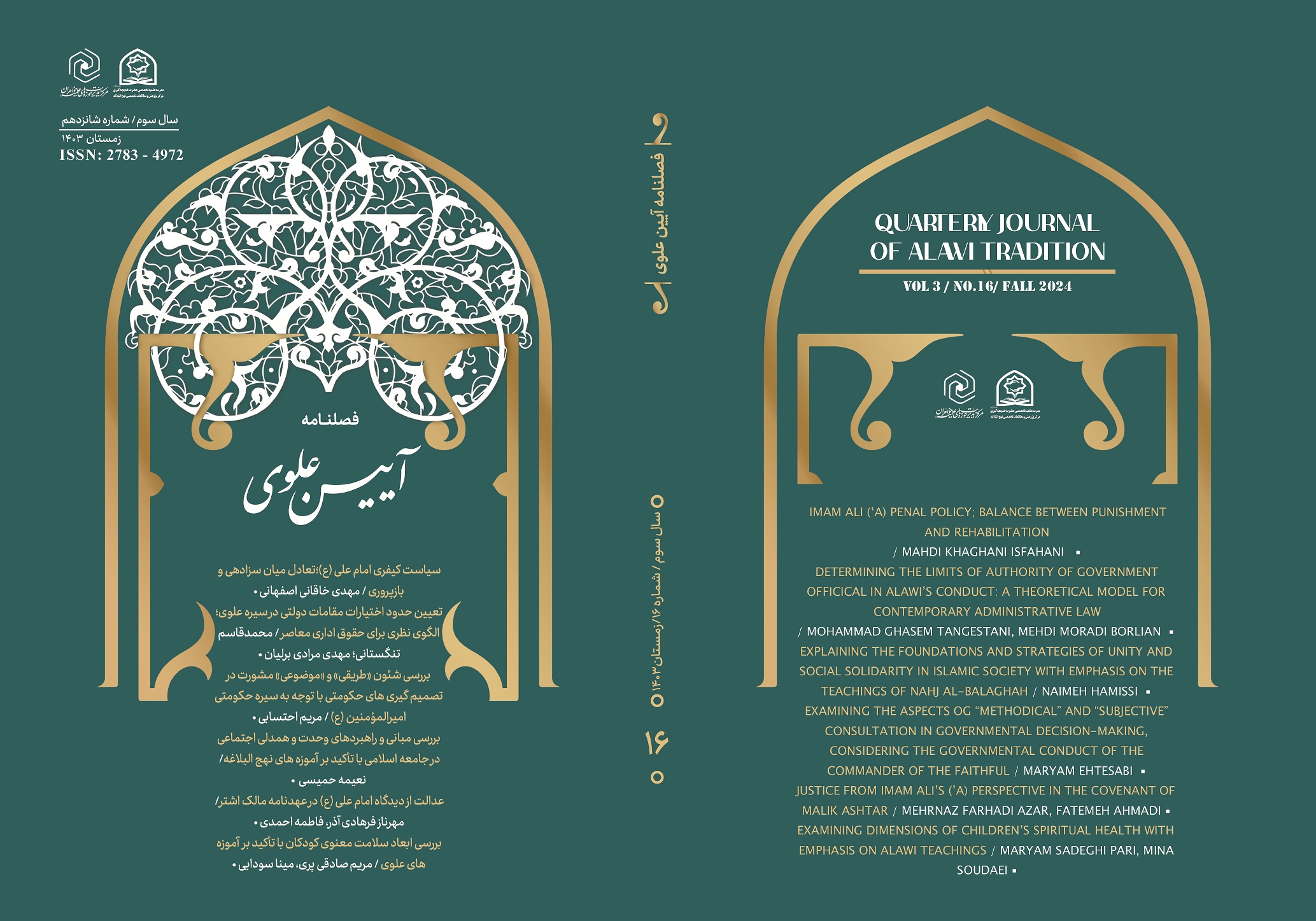
نوع مقاله : مقاله پژوهشی
عنوان مقاله English
نویسنده English
Criminal policy is a relatively new field of study in criminal sciences that examines the management of prevention and criminal and quasi-criminal responses (alternatives to harsh punishments) in order to control deviations and crimes, before and after they occur, by adopting a set of preventive, punitive, deterrent, painful, disciplinary, compensatory, and rehabilitative measures. Through the thematic categorization of Imam Ali’s (‘a) teachings during the period of his leadership over the Muslim community (formal criminal law of the Alawi government) and before that (enjoying what is right and forbidding what is wrong, non-governmental Alawi) in controlling sins and reacting to criminals, the model of Imam Ali’s (‘a) penal policy makes it possible to extract discursive indicators in the realm of the above-mentioned measures in such a way that the approaches of Alawi criminal justice can be extracted and conceptually formulated. The present article, using a qualitative method and within the framework of Islamic criminal law, analyzes the aspects of Imam Ali’s (‘a) criminal policy in his commands and judgments with the hypothesis that punishment in the implementation of fixed hudud punishments and rehabilitation in the implementation of discretionary punishments (ta’zir) are in perfect balance, and a balanced and comprehensive criminal policy, respecting the diverse individual and collective interests and goals, has the capacity to correct many of the shortcomings of the modern criminal law system of the Islamic Republic of Iran and Islamic countries that follow the model of Iranian criminal law
کلیدواژهها English
نوبهار، رحیم، سیاست جنایی شفاهی ایران بر اساس مصاحبه با اساتید و پژوهشگران (کیفرگذاری و کیفردهی)، ج 4، تهران: نشر میزان، 1403.